|
 |
Below are a couple of extensive source articles on the Narragansett
Pacer,
sent in by Jennifer, and also a letter that raises the question - -
Are Narragansett Pacers still in existence on an island, south of
Fiji? |
|
|
|
The Mysterious
Narragansett Pacer
By LaVONNE HOULTON
Parts 1 and 2 of 3 Parts |
In the book entitled History of the
New World Called America, published in Dublin, Ireland, in 1775, it
is said of the Rhode Island colonists that "they have a breed
of small horses, which are particularly hardy. They pace naturally . . .
with such swiftness and for so long a continuance as must appear almost
incredible to those who have not experienced it."
The historian was describing the earliest light horse breed developed by
the American colonies - - the Narragansett Pacer. However,
after existing for some 200 years, the pure breed quite abruptly became
extinct.
Brief references are made to the Narragansett Pacer in contemporary
literature about horses, but the full story of this vanished breed is
scattered in bits and pieces throughout old histories, out-of-print
studbooks, and New England genealogies. Consequently, the old
"Rhode Island horse" has attained an aura of mystery in modern times.
Because of the Narragansett Pacer's valuable contribution to some of our
existing breeds, we should solve the mysteries of where he came from,
what he did, and why he became extinct. A thumbnail history of the
various breeds of horses brought to the two Americas in earliest times
is essential to solving the first question concerning our colonial
equine hero.
|
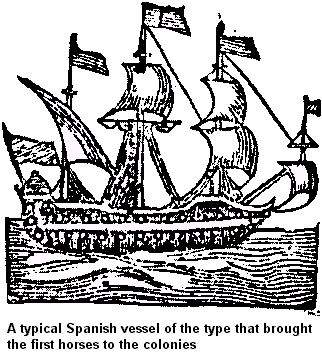
| The first horses to
be transported to the New World were Spanish Jennets, brought over
by Christopher Columbus on his voyages of discovery.
After his first voyage in 1492, he brought over a number of
stallions and broodmares in 1493. The Spanish Jennet, a
small pacing horse of primarily Libyan extraction, was one of the
most popular breeds of the Middle Ages. Nearly every
ship from "home" brought horses to the colonies along the Spanish
Main for the next few decades. The Spanish breeds were all
related to some degree. The Jennets and their northern cousins, the
Galicians and Asturians, were natural pacers. Others of the period
were the Andalusian and the wonderfully even-tempered Barb from
Tripoli. |
 |
|
In the early 1600's, when
France, England, Denmark, and Holland all sought to break Spain's
monopoly in the Caribbean, Dutch ships also transported horses for sale
to the Spanish colonists. Holland's best breed was the
Friesian or so-called "Dutch horses" - fine, black animals -
medium-sized, compact, and strong, with excellent legs, great endurance,
and "devilish" dispositions. Because of their swift, slashing
trot, they were also called Hart-dravers (fast trotters).
The French were next to bring horses across the ocean, beginning in 1604
when M. L'Escarbot, a lawyer, took horses from Normandy and Brittany to
Acadia. Colonists took some of these horses to Quebec in 1608. The
Bidets of Brittany had been known for excellence for years. They
traced back to Libyan stock and were rather small horses, usually black,
renowned for great hardiness and endurance. The Norman Horse was
one of the large destriers (war-horses) that for several centuries
carried northwestern Europe's armored knights.
Percheron Postiers, small post or coach horses from Perche, France, were
brought to Canada in 1634 by Robert Giffard and 100 farmer/colonists.
These horses were a cross of the old heavy horse of Europe on fine
Libyan stock brought up from Spain.
A very fine stallion, sent to Quebec in 1647, and 12 excellent horses
from the stables of King Louis XIV, brought over around 1665, were most
probably Limousin horses - a breed called "the glory of Old France" and
one which filled the royal stables in this period. Highly
esteemed as saddle horses, they had their origin in the 8th century
A.D., and distinctly showed Barb characteristics. Nearly all
the ancient, excellent breeds in France derived from oriental stock
which traced to the Libyan horse of antiquity.
Horses from England were introduced into Virginia as early as 1609.
Although the initial group all perished during the "starving time" that
year, more soon followed, and by 1620 Virginia's horses were considered
to be of fine quality.
Horses first appeared in the New England regions in 1625 when the Dutch
brought a few Flemish draft horses to New Amsterdam. In 1629
Francis Higginson brought 25 mares and stallions from Leicestershire,
England, to the Massachusetts Bay Colony. That same year
marked the arrival of seven more mares and one stallion at Salem.
A few stallions shipped aboard the Mayflower and the Whale landed safely
at Charlestown Harbor in 1630, though most of the livestock had died
enroute.
In 1635, 27 Flemish mares and 3 stallions were brought to Salem by two
Dutch ships. These horses of Flanders were the product of an early cross
of the old European heavy horse on Libyan stock from the Mediterranean.
The Flemish stock left but little trace of its existence after a few
years in America. The patroons of New Amsterdam, of course,
preferred their fast Dutch Hart-dravers for transportation purposes.
Since the cost of shipping a horse from England to the New World was
quite high (10 pounds in 1630), and the voyage was rigorous, only young,
healthy stock of good blood was considered worthy of export. The
earliest New England stock, used primarily as saddle horses, represented
quite a variety of European breeds, most of which bore significant
inheritance from their ancient Libyan ancestors. From
England came a "duke's mixture" which blended the old, black English
war-horse with stock from the low countries and with horses of North
African blood.
Other horses from the British Isles were the fine Barbary Horse, well
known in England since Elizabethan times, and the exceptional black
Irish Hobby. The Hobby dated from the 10th century A.D., and
was considered to be the best of the English breeds up into the 17th
century. Its earlier names were Haubini and Astercones - the
latter because they came from Asturia with Spanish colonists.
The Asturian was a pacer, and the Irish Hobbies were also greatly prized
as saddlers because they had "so gentle a pace."
The Libyan horse, from which so many of Europe's breeds derived, had its
origin in the area of North Africa between the Nile and the Atlantic
Ocean, where Libyan tribesmen had developed a fine mastery over the
horse as early as the 14th century B.C. The Libyan is
considered to be one of the finest breeds ever known. These horses
were uniformly bay in color and marked by a star on the forehead.
They had extreme speed, great endurance, a high degree of beauty, and
exceptional docility. Their breeding was kept pure for hundreds of
years under the careful attention of tribal kings. The mobility of
the desert tribes brought about the introduction of Libyan horses to
Egypt, Greece, Arabia, Spain, and other lands at a very early time.
Hannibal stationed more than 2,000 Libyan stallions with his cavalry on
permanent duty in Spain in 219 B.C. In the Andalusian region,
the pacing Spanish Jennet evolved from Libyan stock crossed on native
mares, and was later improved by in fusions of the same blood through
Arab and Berber horses brought in by Moorish invaders. The
Jennet retained the beauty, docility, and remarkable endurance of the
Libyan horse, as well as its color and relatively small size.
In the north of Spain the Libyan blood was diluted through crosses with
the old striped dun of the Sierras and with large German stock brought
in by Vandal and Visigoth raiders.
Here developed the two pacing breeds, Asturian and Galician. The common
characteristics of the various European pacers - gentle nature,
strength, endurance, great swiftness, and an easy-to-ride amble or
pacing gait - were identical to those of the Narragansett Pacer of
Colonial America.
The best European breeds traced to the ancient Libyan, and individuals
of those breeds of oriental derivation were brought to the Americas
right from the start. The first horses taken to Rhode Island were
apparently offspring of the animals that had been imported to the
Massachusetts Bay Colony less than a decade before.
Quite logically then, the foundation stock of the Narragansett Pacer was
a mixture of the Dutch, Irish, and English breeds mentioned above. The
pacing characteristic was set in ancient Libya, replenished in Spain,
diffused throughout the European continent, and eventually transported
across the Atlantic Ocean to re-establish itself in a new world's new
breed.
Colonial New England had a variety of horses, and among them the pacing
gait was quite common. Before 1660, English nobles kept two kinds of
horses - the huge destrier, or war-horse, that was led until
ridden in battle or when engaged in tournaments, and the "ambler" or
pacer, used for riding from place to place.
Then King Charles lI's tremendous interest in flat racing fostered a
complete change in the concept of the "ideal" horse in England.
Following the king's lead, England's horsemen took up the breeding of
running stock. The change was so dramatic that it was said that by 1700
scarcely a pacer could be found in all of England. While some had been
brought to New England in the early part of the 17th century, a good
many more pacers undoubtedly found their way there when the British
fashion changed.
Rhode Island colonization began in 1636. Portsmouth, the second
settlement, was founded in 1638 by William Coddington. That year the
Portsmouth proprietors voted to distribute land among themselves at the
rate of 1 acre of meadow for each cow or sheep and 1'/2 acres for each
horse. The Narragansett Bay region was ideally suited to development of
a large plantation system, where a temperate climate, warmed by the Gulf
Stream, and fertile soil rich in iodine and bromine, promoted growth of
unexcelled meadows and hay crops. The lower coastline of the bay,
especially at Point Judith Neck, formed a perfect range with natural
barriers for containment and development of a specific breed of horses.
Horses soon became a prime product of this area. Their
environment promoted good health and fertility. Stock
increased so rapidly that within a dozen years or less horses were being
exported from Rhode Island to Massachusetts, New Amsterdam, and even to
far-off Barbados, nearly 1,000 leagues away. Barbados, settled by the
British in 1625, had established trade with New England and Virginia by
1634. In 1640, Barbados obtained cane plantings from Brazil
and sugar became her greatest export product.
Columbus had taken sugar cane to Santo Domingo in 1493. By 1515 a
wealthy physician there had brought in, at his expense, sugar masters
and technicians from the Canary Islands. A trapiche,
or horse mill, was built for extracting juice from the cane.
The trapiche was a very primitive piece of machinery consisting
of two or three "cylinders" made from large peeled logs.
These rollers were geared to a long shaft which was turned by horses.
As cane production increased throughout the Caribbean, demand grew for
more and 'more horses to turn the trapiches and pull carts to and
from the mills. Horses for these cane mills were among Rhode
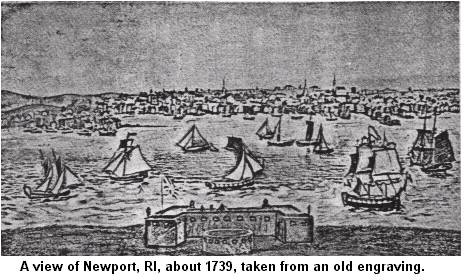
Island's first exports to the West Indies, and Newport became the
principal port from which they were shipped. A description
of the Barbados in 1648 stated, " they want (lack) rivers to turn their
sugar mills, so that New England sendeth them Horses and Virginia Oxen,
to turn them, at excessive rates." '
The first Rhode Island lawsuit, in May, 1656, concerned horses claimed
by William Brenton which William Coddington was about to ship to
Barbados. Coddington was one of Newport's commissioners to the
General Assembly and a past-president of the assembly. Brenton,
also active in colony affairs, served as a member of the Court of
Commissioners from Providence and later was president of the General
Assembly. The town of Providence set taxes in 1664, payable in "wheat,
peas, or pork, at 3 pounds 10 shillings per barrel, or horses or cattle
equivalent."
Around 1660, Peleg Sanford & Brothers established themselves in Barbados
as factors for Boston and Newport merchants. In this capacity they
received horses, sheep, and farm produce from Rhode Island to exchange
for West Indian sugar, rum, molasses, and cotton.
By 1670 new blood was being added to the old Narragansett stock. Captain
John Hull, one of the original purchasers of the Narragansett Tract,
raised horses of his own breeding on farms in Boston Neck and Point
Judith. He urged his partners to help concentrate choice stock there to
produce the best possible horses for West Indian export.
The last decades of the 17th century saw great expansion of New
England's merchant fleet. In 1676 Massachusetts alone had 430 ships in
trade. Soon after, Bristol, R.I., had 15 ships trading with the West
Indies and on the Spanish Main. By 1686 Colonel Nathaniel Byfield
shipped Narragansett Pacers to Guiana on the Bristol Merchant - an
odorous voyage for the cargo contained red onions as well as horses.
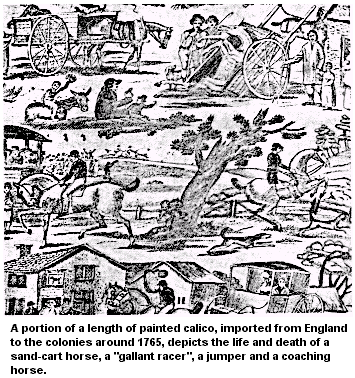
Now, comfortable horses were in great demand both in the colonies and
the sugar isles, for they made excellent pleasure mounts. So extensive
was the market for pacers that other horses were taught to pace. As
early as 1690 pace-trainers came into vogue, .especially around Ipswich,
Massachusetts.
Their methods were "trammelling" and "cross-spanning." Logs were placed
across training roads at certain intervals to induce a pacing gait. An
early chronicler reported that "the way in which a horse was learned to
pace was by fastening his two right and two left feet together with
leather straps, so that the two former might step together, and then the
two latter." These methods were in use for about 80 years.
Until the eve of the Revolutionary War, the Atlantic sea-lanes teemed
with ships, and horses by the hundreds were transported down the coast
to the Caribbean. In 1716, for example, a Captain Hutton shipped 45
horses to Barbados. A fleet of six ships left New London, Conn.,
in 1724, bound for the West Indies, carrying horses tethered on deck.
Brigs in those days could carry 49 horses per cargo, and sloops (which
normally made two trips per year) held up to 35 hobbled on deck, with
other cargo stored below.
|
 |
Between 1741-56
little Rhode Island, just 48 miles long by 37 miles wide, kept more
ships at sea than any other colony. In the period from
1765-1775, New England alone exported 37,000 horses and other
livestock. An interchange of racing was also common by
mid-century between Rhode Island and Virginia. Races
were held twice a year on the hard, sandy beaches of Newport and
Narragansett.
Sportsmen gathered from far and near to watch these pacing contests
for which the winner always received a silver tankard.
George Washington (whose mother rode a pacer when she was a child)
favored the Narragansett Pacer, and is known to have raced at least
one of them. Some of the breed's best individuals went
to the southern colonies where racing was very popular.
|
 |
|
Narragansett Pacers were
the fastest pacing horses in the colonies. They could pace a mile
in just a fraction over two minutes and easily covered three miles of
uneven, rocky ground in seven minutes - an average of 2:33 for the mile.
Long trips in short time were of common occurrence.
The Narragansett Pacers were ideal saddlers for more reasons than just
speed. They were noted for ease of motion, which propelled
the rider in a straight line without any side-to-side or up-and-down
joggling. Such comfort in the saddle made long trips
possible in the sparsely settled colonies. These pacers were
extremely surefooted, an added blessing in an uncleared land.
They were tough, hardy animals, noted for great stamina and endurance.
That they were favorite mounts for women attests to their calm,
tractable natures.
Narragansett breeders liked colorful names for their pacers, choosing
such sobriquets as: Peacock, Grand Turk, Revival, Jolly Farmer,
Whirligig, Rainbow, Smiling Ball, Free And Easy, and Feather. New
Yorker, Rip Van Dam purchased a Narragansett Pacer in Rhode Island in
1711 for $160. The horse was sent almost immediately to
Philadelphia where the consensus was that, while high-priced, he was "no
beauty." Van Dam's pacer had a playful, nervous temperament.
He never stood still, and he had a taste for beer, wine, and hard cider!
Colonel Wadsworth of Hartford, Conn., owned Whirligig, a full-blood
Narragansett Pacer of "exceptional carriage, spirit, and movements" that
stood at stud in the 1780's. Whirligig was famous in his
day, and news that he had been sold for a "vast sum of money" created
quite a stir throughout the country. Whirligig's offspring
included Young Rainbow, said to equal his sire in grace and agility, and
Young Kitt, a spirited, dark sorrel stallion that could trot and canter
as well as pace rapidly - unusual for a purebred.
Smiling Ball, taken to Connecticut in 1785, was a descendant of Old Snip
from Tripoli. He paced exceedingly fast, and was unbeaten in
races.
Free And Easy, a full-blood Narragansett Pacer, was advertised at East
Windsor, Conn., 1785-87, at the low price of "$1.00 the single leap,
$2.00 the season, to encourage those having likely mares of the same
breed to bring them, that the breed so valuable may not be lost."
He was a good looking, well-proportioned stallion, strong and active,
the pride of his owner.
Hannah Robinson owned a "splendid Spanish Jennet or Narragansett Pacer,
named Selim," whose sire and dam had been imported from Andalusia by her
grandfather, William Robinson.
A bright bay stallion with black points was advertised at Kensington,
Conn., in 1793 as "the only one in the world of the Narragansett
breed unmixed." This horse, King Philip, was purportedly
the sole remnant of his breed by 1800.
During the War of 1812 the captain of a British man-of-war had agents
searching throughout the Narragansett area for a Narragansett Pacer to
give his wife. But not a single full-blood pacer was to be
found. There has been much conjecture about why this breed became
extinct. One school of thought held that Narragansett
breeders exported so many pacers that they depleted their stock.
However, the canny Yankee traders would hardly have been guilty of such
poor judgment.
Others felt that improved roads and the corresponding switch to coach
and carriage killed the popularity of the Narragansett Pacers.
Yet it seems there would still have been loyal breeders and at least a
limited market for such easy-gaited saddle horses. It would
then have taken longer than 20-odd years for these pacers to die out.
The breed established by the Vermont stallion, Justin Morgan, at the
close of the 18th century also faced the problem of obsolescence a few
generations later. Faithful breeders, however, nurtured
their small purebred bands of Morgan horses and today Morgans are found
in large numbers throughout the United States, and there are many in
Canada as well. This should also have been true of the
hardy, popular Narragansett Pacer, had it not been for some drastic
happening within a short period of time. A great and sudden change
did, in fact, take place, and the answer to this riddle is clearly
spelled out in the pages of Rhode Island history.
Fortunately, the blood of the Narragansett Pacer was not lost when the
breed vanished from Rhode Island. It was literally banished to the
frontiers of Canada, Indiana, Missouri, Kentucky, and Tennessee, where
in 1901, the bloodlines were still appreciated and preserved for the
luxurious saddle gaits which they alone transmitted.
|
|
- - Western
Horseman, April, 1969 -
This is the letter that speaks of the little island horses that pace.
- - Jennifer |
|
 |
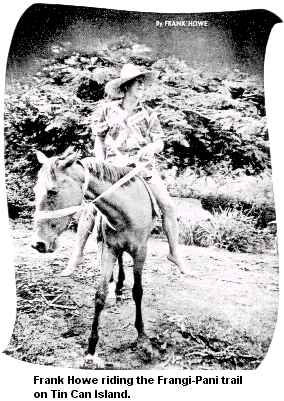
This is being written on the
high seas, but from very low in the radio room of an inter-island
copra boat 300 miles or so east southeast of Fiji. Sorry
I have only one picture, but it was taken by a Tongan while I was
riding the Frangi-Pani trail on Tin Can Island in the Kingdom of
Tonga, South Pacific.
Anyway, this is the way I have
been getting in condition to ride the Quilty in Australia; riding
the Frangi-Pani over mountain trails strewn with palm fronds,
coconuts, and mangos and counting wild pigs with another Papalangi.
The pace is steady, but not as fast as the Tevis Cup Ride.
There are hundreds of horses in
the Kingdom of Tonga, and these "horses" range between 12 and 13'/2
hands high. Most are sorrels, with a scattering of grays
and bays. Some of the horses on the main island of Tonga
Tapu, and some on Neiutopatapu, Vavau, and Tin Can Island, are of
good conformation. Every pony I saw on Neiutopatapu was
a single-footer, and looked like they might carry blood from either
the Tennessee Walker or one of the Pasos. They
were smooth walking, with a very fast gait and accented head
nodding. |
|
| No one seems to
know much of the origin of these horses; but they have straight
legs, straight pasterns, and straight shoulders but are still good
walkers. They have long and silky tails. No saddles are
used, but occasionally a. gunny-sack is thrown over the withers.
No pack saddles are used for carrying copra; and, while you do see
men riding on horseback, I never saw a woman riding. Saw a few
bits made of rough sennit, and most of the headstalls are made of
palmetto leaves, usually into a rough hackamore. Shoes for
horses are unheard of, but hoofs consequently are good, hard, and
usually black. Ponies are usually broke as yearlings and
two-year-olds, and fillies are bred at two. There are no vets, no
horse medicines of any kind, and worming is unheard of. Horse
feed is catch-as-catch-can, plenty of grass, brush, etc., and
just whatever pickin's the horse can find. |
 |
| Here is a wonderful chance for any
of your Junior Horsemen to send old copies of The Western Horseman, or
4H manuals, or any horse literature to young pen pals. These Tongan
youngsters are friendly and speak and read English, but have no way of
getting any information to help them care for their ponies. If any
youngsters want to have a pen pal from here, they can write or send
pamphlets to: Tu'Ifua Esau
c/o Mathesian Utulei
Vavau
Tonga,
South Pacific
It will be worth their while to get
a thank-you note from these friendly islands, because the stamps are
fabulous! I guess you all know I hope to ride in the Quilty the
19th of April, and now expect to go to New Zealand and into the
mountains near Milford Sound. Great trout fishing; and expect to do a
little hunting for wapiti, sambur, Himalayan thar, and Japanese sika.
Keep things humming in Colorado, and I hope to see you at the end of the
year!
Frank Howe
|
|
|
|
|
|
|
|
|
|
|
|